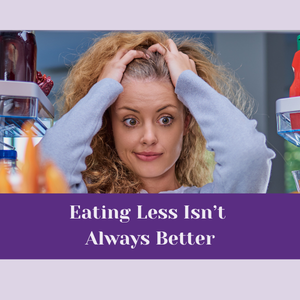
If you’ve ever tried eating less to lose weight… and somehow felt more stuck than ever — you’re not alone.
One of the most common patterns I see in my practice is people doing everything they can to “be good” with their eating — cutting calories, skipping meals, avoiding foods — only to find their progress slows down or completely stalls.
It’s frustrating. And confusing.
But there’s a reason this happens — and once you understand it, everything starts to make a lot more sense.
The Hidden Problem: Your Body Adapts (“Conservation Mode”)
Your body is not designed to lose weight easily — it’s designed to keep you alive.
When you consistently eat too little, your body interprets that as a potential threat. Instead of continuing to burn energy efficiently, it begins to conserve.
This is known as metabolic adaptation — or what I often call with my clients, “conservation mode.”
You may notice:
- lower energy levels
- increased cravings
- excessive hunger (true physiological hunger, not boredom or stress)
- late-night cravings
- feeling cold or fatigued
- slower weight loss — or none at all
From your body’s perspective, it’s doing exactly what it’s supposed to do.
But from your perspective, it feels like nothing is working.
The “Sweet Spot” Most People Miss
Many people assume there is one “perfect calorie number” for weight loss.
In reality, there is a range — what I call your calorie sweet spot.
This is the range where:
- your body is getting enough fuel to function well
- you are not overly hungry or overly full
- “food noise” is quiet
- AND weight loss can still occur
When clients are in this range, they often notice more consistent and sustainable progress — sometimes even better than when they were eating less.
What Happens When You Fall Outside the Sweet Spot
Too low:
→ your body conserves energy
→ weight loss slows
Too high:
→ weight may maintain or increase
Sometimes the signs are subtle:
- losing only ~0.2 lbs/day or fluctuating
- gaining 0.2–0.4 lbs despite “eating less”
- stalled progress despite doing everything right
- feeling like your body is on the “struggle bus”
Why the Scale Can Be Misleading
This is where many people lose confidence — unnecessarily.
Weight fluctuations are not always fat gain.
Common causes of temporary increases include:
- higher sodium intake
- higher sugar intake
- alcohol
- large late meals
- inflammation
- hormonal shifts
You might see:
- a 2–4 lb increase overnight
- followed by a drop a few days later
That’s often water retention masking real progress.
Important: Coming Out of Conservation Mode
When you begin eating enough again, one of two things often happens:
- the scale goes up first
This is normal.
Your body is essentially asking:
“Can I trust that food is coming consistently again?”
Once that trust is established:
- many people experience a pattern of gain → then steady loss
I’ve seen this happen over and over in practice.
Why “Eating Less” Backfires
At first, eating less can lead to weight loss.
But over time:
- Metabolism slows
Your body burns fewer calories at rest.
- Hunger hormones increase
You feel hungrier — more often.
As I often tell clients:
“You can eat like a bird… until you eat like a horse because you let yourself get overhungry.”
- Energy decreases
You move less — often without realizing it.
- Muscle mass declines
Especially without enough protein or strength training.
֎ Less muscle = slower metabolism
What to Do Instead: Support Your Metabolism
The goal is not to eat as little as possible.
The goal is to eat in a way that supports your body while creating sustainable change.
✔ Focus on balanced meals
Include protein, carbohydrates, healthy fats, fiber, and fluids.
✔ Eat consistently
Skipping meals increases stress on the body and often leads to overeating later.
✔ Prioritize protein
Protein supports muscle mass and satiety.
It also has a higher Thermic Effect of Food (TEF) — meaning your body burns more calories digesting it.
Here’s the simple breakdown:
- Protein: burns ~20–30 calories per 100 eaten (20–30%)
- Carbohydrates: burns ~5–10 calories per 100 eaten (~5–10%)
- Fat: burns ~0–3 calories per 100 eaten (0–3%)
In simple terms:
Your body has to work harder to process protein — which supports and increases metabolism.
✔ Support movement
Strength training and daily movement help maintain metabolism.
✔ Manage stress
Chronic stress increases cortisol, which can slow progress.
✔ Get adequate sleep
Poor sleep increases ghrelin (your hunger hormone).
As I tell clients:
“Ghrelin is like gremlins coming out after midnight — it shows up when you stay up too late.”
✔ Stay consistent after “off days”
If sodium, sugar, or alcohol caused a temporary increase:
- hydrate
- return to your normal routine
- avoid overcorrecting
✔ Let go of “all-or-nothing” thinking
Sustainable habits matter more than extremes.
This Is Where Most People Need Guidance
Many people don’t realize they are under-eating — especially when trying to “be healthy.”
What looks like discipline on the surface can actually be the very thing slowing progress underneath.
This is where individualized guidance can make a significant difference.
Download: Calorie Awareness & Metabolism Guide
Calorie Awareness & Metabolism Guide
Ready for a Plan That Actually Works?
If you’re feeling stuck, here are two ways to get started:
💜 Book an Appointment
or
💚 Start with a Strategy Session
We’ll create a plan that supports your metabolism and your lifestyle.
References
- Hall KD, Sacks G, Chandramohan D, et al. Quantification of the effect of energy imbalance on bodyweight. Lancet. 2011;378(9793):826-837. doi:10.1016/S0140-6736(11)60812-X.
- Leibel RL, Rosenbaum M, Hirsch J. Changes in energy expenditure resulting from altered body weight. N Engl J Med. 1995;332(10):621-628. doi:10.1056/NEJM199503093321001.
- Dulloo AG, Jacquet J, Montani JP. Adaptive thermogenesis in human body weight regulation: more of a concept than a measurable entity? Int J Obes (Lond). 2012;36(6):791-798. doi:10.1038/ijo.2012.62.
- Westerterp KR. Diet-induced thermogenesis. Nutr Metab (Lond). 2004;1(1):5. doi:10.1186/1743-7075-1-5.
- Spiegel K, Tasali E, Penev P, Van Cauter E. Sleep curtailment in healthy young men is associated with decreased leptin levels, elevated ghrelin levels, and increased hunger and appetite. Ann Intern Med. 2004;141(11):846-850. doi:10.7326/0003-4819-141-11-200412070-00008.
- Karpinski C, Rosenbloom C. Sports Nutrition: A Handbook for Professionals. 5th ed. Academy of Nutrition and Dietetics; 2017.